

Strictly speaking, no panel PC is waterproof. What exists is a set of ingress protection ratings — and the only useful question is which one matches your cleaning regime.
Choosing a waterproof industrial panel PC starts with understanding what the ingress protection (IP) rating actually guarantees and what it does not. An IP code tells you how well an enclosure seals against dust and water. It says nothing about corrosion resistance, hygienic design, sunlight readability, or whether the touchscreen still responds to a wet-gloved hand. The sections below match IP65, IP66, and IP69K to your cleaning regime, compare 304 and 316 stainless, and cover the mounting and I/O details that separate a five-year installation from a first-season failure.
Why the IP Rating Matters in Washdown Environments
In food and pharmaceutical plants, panel PCs rarely die of old age — they die of water. Daily hose-downs, foam cleaning, and caustic chemicals find every unsealed connector, every coating chip, and every gasket that has hardened past its service life. The ingress protection (IP) rating, defined by IEC 60529, is the first line of defense, and it pays to read the code closely.
The code has two digits. The first rates protection against solids from 0 to 6, where 6 means completely dust-tight. The second rates protection against water from 0 to 9, and this is the digit that matters most in washdown environments. The quick IP rating chart below covers the range that matters for panel PCs:
| Rating | Water protection |
|---|---|
| IP65 | Withstands low-pressure water jets from any direction |
| IP66 | Withstands powerful water jets from any direction |
| IP69K | Withstands high-temperature, high-pressure washdown (80 °C jets) |
A note on US spec sheets: NEMA 4X is broadly equivalent to IP66, though NEMA also adds corrosion-resistance requirements. That is why the enclosure material in the next section matters as much as the rating itself.
For a broader framework covering brightness, compute, and expansion decisions, see our complete industrial panel PC buying guide.
IP65 vs IP66: Which Rating Does Your Station Actually Need?
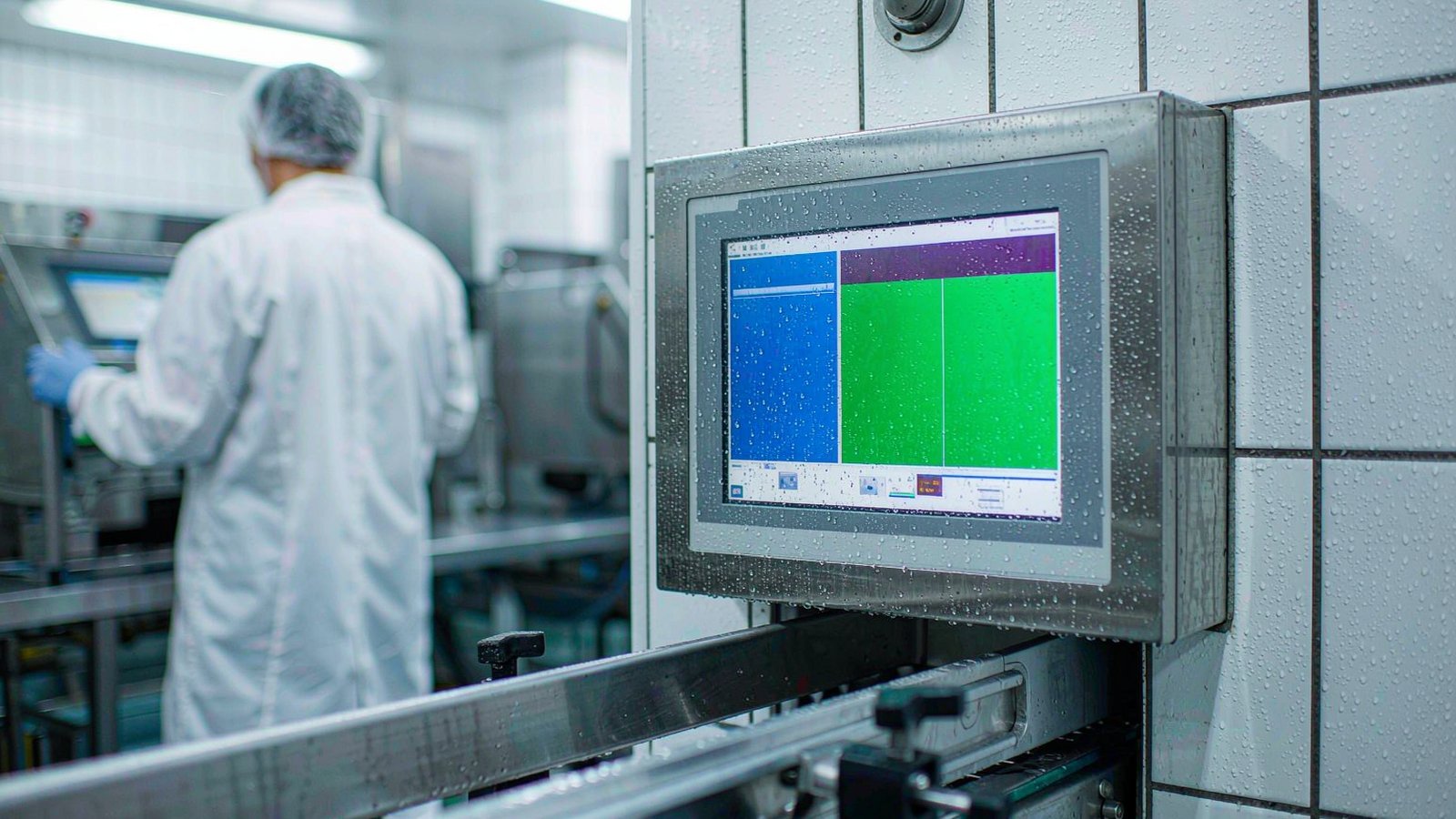
Most plants need both, in different zones. Map your floor by water exposure and cleaning intensity, then spec each station accordingly.
Where IP65 Is Enough
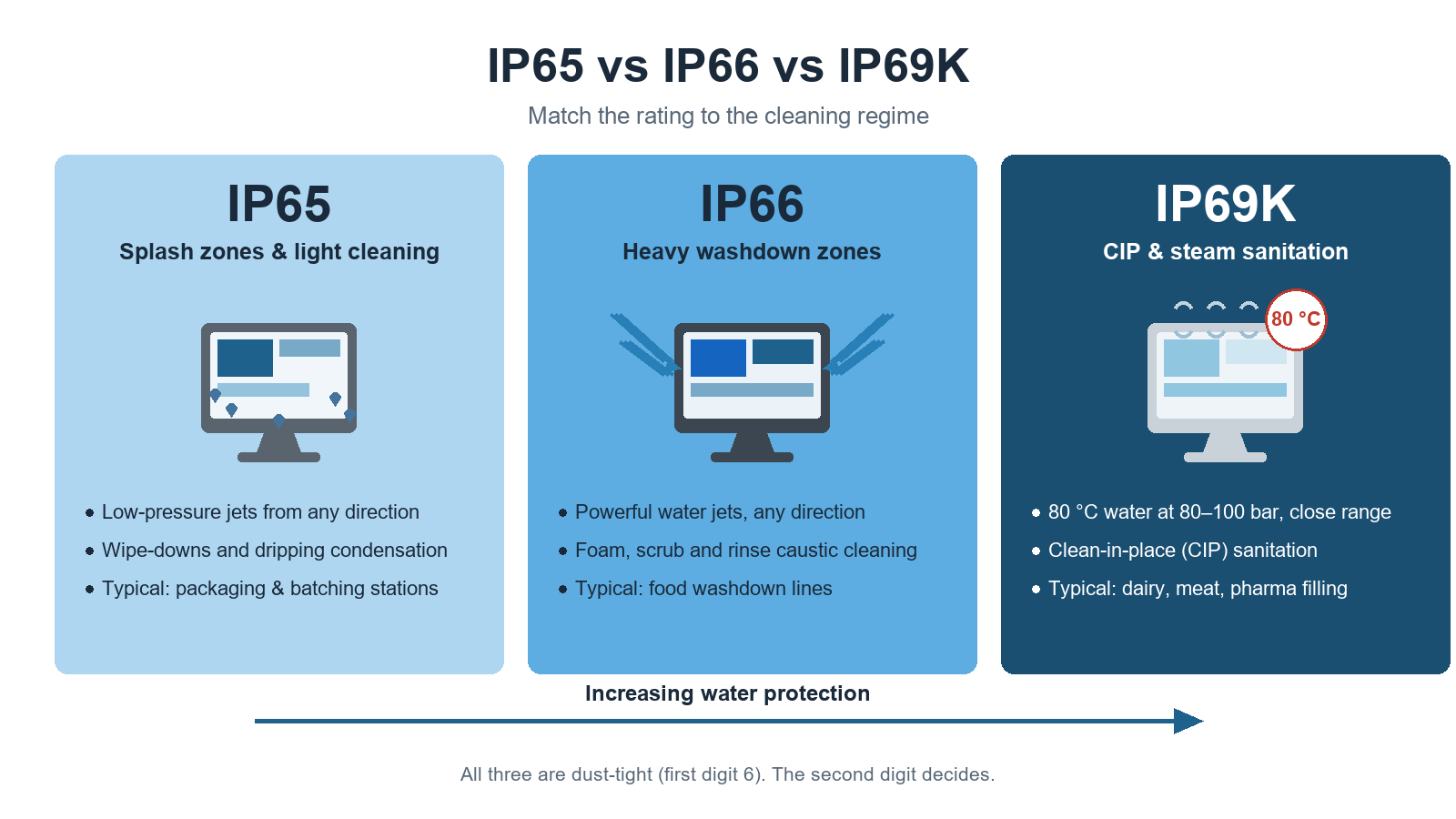
Packaging stations, batching tables, and control posts that only see occasional splashes and wipe-downs do not justify IP66 pricing. An IP65 industrial panel PC handles low-pressure jets and dripping condensation without issue, costs less and is available in far more configurations. If your cleaning procedure is “spray the floor, wipe the equipment,” IP65 is the pragmatic choice.
Heavy Washdown Zones Demand IP66
IP65 seals are tested against low-pressure jets only — 30 kPa at 3 m. Bring a 30-bar washdown lance within half a metre of the bezel and water will find the gasket.
IP66 is the industry’s washdown baseline, not a high-pressure rating: it is tested with a 12.5 mm nozzle at 100 L/min and 100 kPa (about 1 bar) from 3 m, in any direction. That covers the overwhelming majority of foam-and-rinse routines on food lines.
What it does not cover is close-range, high-pressure lancing. If your sanitation crew uses a 30-bar lance, or if the procedure includes hot water, the rating you actually need is IP69K — and IP66 will not substitute for it, no matter what the enclosure is made of.
When You Actually Need IP69K
The difference between IP66 and IP69K comes down to temperature and pressure. IP69K adds protection against close-range cleaning with 80 °C water at roughly 80–100 bar, the regime used in clean-in-place (CIP) and steam-sanitized lines in dairy, meat, and pharmaceutical filling. If your sanitation team runs hot-water or steam rinse cycles, IP69K is the only rating that matches the procedure; an IP66 unit will survive the jets but not the thermal cycling. Lunox builds IP69K units to custom order for exactly these lines.
Stainless Steel or Coated Aluminum?
If you are new to this hardware category, start with what an industrial panel PC is and how it differs from consumer hardware, then come back, because in wet plants the enclosure material quickly becomes the deciding factor.
Powder coating fails at bezel edges, mounting holes, and cable glands — usually within the first two years. Caustic foam lifts the coating at every scratch; once bare aluminum is exposed, chlorides pit it within months. Repainting a panel PC in service is not a realistic option.
For washdown duty, a stainless steel panel PC is the baseline, and the real choice is between two grades. SUS304 is the workhorse: it handles most food environments, daily caustic cleaning, and ambient humidity without trouble, and it keeps cost down. SUS316 adds 2–3% molybdenum, which greatly improves corrosion resistance to chlorides and acids. Spec 316 when the line touches seafood, brines, or aggressive acidic cleaners, or when the plant sits in a coastal area with salt-laden air.
Construction matters as much as grade. A genuine food-grade enclosure is stamped as one piece, or continuously welded and ground smooth, leaving no crevices where product residue and standing water collect. Multi-piece screwed-together enclosures stack up gasket joints, and gasket joints are exactly where washdown failures start. Ask the vendor how the front bezel is sealed, not just what it is made of.
Touchscreen Selection for Wet and Gloved Hands
Two touchscreen technologies cover virtually every wet-environment scenario. Picking the wrong one shows up on day one.
Projected capacitive (PCAP) touch is the default for most food plants. It supports multi-touch and responds to wet hands and thin nitrile gloves; the glass front wipes clean easily and keeps its optics through years of washdown. The caveat: a standard PCAP controller can false-trigger under a heavy film of water, so confirm the unit uses a wet-hand-tuned controller. This is the most common complaint about generic capacitive screens.
Resistive touch still earns its place at pharmaceutical filling and weighing stations where operators wear double gloves, or where a stylus is used. It ignores water films entirely and costs less, at the price of lower optical clarity and a single-touch surface that wears over time.
If you are weighing a sealed computer against a separate display for your line, our panel PC vs touch monitor comparison lays out when each setup wins.
Hygienic Design: Food & Pharmaceutical Compliance Requirements
An IP rating protects the computer; hygienic design protects the audit.
On the food side, a washdown panel PC for food processing should present a flat front bezel with no dead corners, recesses, or exposed fasteners where product residue can accumulate and microbes can harbor. HACCP plans, 3-A sanitary standards, and FDA material guidance all point the same way: surfaces that shed water, drain quickly, and survive aggressive foam cleaners without degrading. A flush glass front with rounded transitions is far easier to defend in an audit than a bezel with decorative grooves.
Pharmaceutical plants add another layer. A panel PC for pharmaceutical cleanroom use must control particle shedding, which makes a fanless design effectively mandatory, and tolerate daily wiping with disinfectants such as hydrogen peroxide without clouding the front glass or attacking the gaskets.
Need a washdown panel PC that passes your next HACCP or GMP audit? Send us your cleaning procedure and we will confirm the rating, material and touch configuration for that station.
Mounting and I/O: Details That Make or Break Washdown Duty
Mount by hygiene zone: panel-mount the unit flush into the machine or wall inside hygiene areas so the face sits flush and cleans in one pass; use a swing-arm mount outside hygiene zones where flexibility matters; use VESA mount for standard arms and stands.
I/O is where most “waterproof” installations leak anyway. Standard USB and RJ45 ports are the first entry points for water. Insist on IP65-rated I/O with M12 circular connectors, the sealed screw-lock type standard on industrial equipment, for any port that stays live during washdown. Finally, conformal coating, a thin moisture-resistant lacquer applied to the PCBA (printed circuit board assembly), adds a safety net for humid, non-washdown corners of the plant.
Outdoor Deployment: Beyond the IP Rating
Not every wet environment is a washdown environment. Outdoors, the IP rating stops being the main event. Four extra factors decide whether the unit survives its first year:
- Sunlight. A 300-nit office panel is unreadable at noon. An outdoor sunlight readable panel PC needs a 1000+ nit, anti-glare display to stay legible in direct sun.
- Temperature. Specify a wide operating temperature range, realistically -20 °C to +60 °C, for docks and cold-storage aprons.
- Condensation. The number one outdoor killer is not rain; it is thermal cycling. A hot unit cooled quickly by evening rain breathes moist air inward, and condensation forms on the internals. Demand condensation management, a sealed enclosure with a breathable membrane or a heater option, plus conformal coating on the PCBA as a second line of defense.
- UV and salt fog. Standard gaskets embrittle under years of sun, and coastal salt air corrodes stainless fasteners that are not 316. Both belong on the spec sheet, not in the warranty claim.
Waterproof Panel PC Selection Checklist
Choosing the right waterproof industrial panel PC ultimately comes down to four decisions: IP rating, enclosure material, touchscreen type, and mounting method. Two more, I/O protection and compliance fit, complete the picture. Run every station through this checklist before you request quotes:
- IP rating: IP65 for splash zones, IP66 for standard washdown routines, IP69K for CIP or steam cleaning.
- Enclosure material: SUS304 for general washdown; SUS316 for seafood, brines, acids, or coastal sites.
- Touchscreen: PCAP for wet hands and thin gloves; resistive for thick or double gloves and stylus use.
- Mounting: panel mount inside hygiene zones; swing-arm or VESA outside.
- I/O: IP65-rated I/O with M12 connectors; no bare USB in the spray path.
- Compliance: flat hygienic bezel and wipeable surfaces for food (HACCP); fanless, disinfectant-tolerant hardware for pharma (GMP).
| Scenario | IP rating | Enclosure | Touchscreen | Mounting |
|---|---|---|---|---|
| Food, heavy washdown zone | IP66 | SUS316 | PCAP, wet-hand tuned | Flush panel mount |
| Food, light-duty station | IP65 | SUS304 | PCAP | Flush panel mount |
| Dairy / meat / aseptic filling, CIP line | IP69K | SUS316 | Resistive or wet-tuned PCAP | Flush panel mount |
| Pharmaceutical, dry area | IP65 | SUS304 / SUS316 | Resistive (double gloves) | Flush panel mount |
| Pharmaceutical, washdown or CIP | IP66–IP69K | SUS316 | Resistive or wet-tuned PCAP | Flush panel mount |
| Outdoor, unsheltered | IP66 | SUS316 (coastal) | PCAP, 1000+ nits | VESA on arm or stand |
What the Rating Actually Costs You
Stainless construction and a higher IP rating are not free, and it is worth knowing the order of magnitude before you open the RFQ:
- IP65 → IP66 typically adds 15–40% to enclosure cost, driven by gasket design and pressure testing rather than materials.
- SUS304 → SUS316 adds a further 20–35% on the enclosure.
- IP69K sits above both, because the seals, cable entries and testing regime all change.
Now put that next to a failure. A single unplanned stop on a filling line is usually measured in hours, and the panel PC is rarely the only thing down while the zone is stripped, dried and re-specified. Add the labour, the lost batch, and the fact that a replacement unit is weeks away, and the incremental cost of specifying one grade higher is almost always the cheaper option.
Two things worth asking your supplier for, because they cost nothing to provide: seal and gasket service intervals, and the actual test pressure behind the IP claim.
Five Questions That Separate Suppliers
Most washdown failures trace back to something that was never on the datasheet. Ask these before you compare prices:
- How is the front bezel sealed? One-piece stamped, or continuously welded and ground smooth? Screwed-together enclosures stack gasket joints, and that is where water gets in.
- What are the actual test conditions behind the IP claim? Nozzle size, pressure, temperature, duration. “IP66 rated” on its own tells you very little.
- Is the touch controller wet-hand tuned, or a generic PCAP module? This is the single most common source of false triggering complaints.
- What is the gasket material, and what is its service interval? EPDM, silicone and Viton behave very differently under caustic foam and thermal cycling.
- Are the components new and original, or refurbished? Refurbished CPUs and panels are common in this category, and they surface as intermittent faults in year two.
Frequently Asked Questions
What is the minimum order, and how long is the lead time?
Lunox accepts single-unit trial orders; MOQ is not a barrier for a first deployment. Lead time depends on configuration. Standard models move fastest, while custom stainless or IP69K builds add enclosure machining and pressure-testing time. Ask for a firm delivery date with your RFQ.
How often do seals and gaskets need replacing?
It depends on cleaning chemistry and cycle count. EPDM and silicone gaskets in daily washdown service are typically inspected every 6–12 months and replaced once they take a permanent set. Get the gasket material and its service interval in writing from the supplier.
What certifications should a washdown panel PC carry?
CE and FCC are the baseline for most export markets, and RoHS applies in the EU. For food and pharmaceutical lines, request material certificates for wetted surfaces and, where relevant, 3-A sanitary documentation. Confirm the current certificate list before ordering rather than assuming.
Can the unit be customized in size and I/O?
Yes. Screen size, bezel cutout, connector types and mounting provisions are the most common customizations, and IP69K assemblies are built to order. Send your cutout drawing and I/O list with the enquiry so the factory can quote accurately.
Why We Can Answer This Properly
Lunox has manufactured industrial panel PCs in our own factory for 15 years. The stainless enclosures and IP69K assemblies in this guide are built on our own lines, not sourced and rebadged, which is why we can build a single unit for your trial run instead of insisting on a container.
Every unit ships with 100% new, original-component parts and a unit-level traceability code, so when a gasket eventually needs replacing you can pull the exact build record rather than guess.
Ready to Spec Your Next Washdown Line?
Still deciding? Send us your zone map or cleaning procedure. Our engineers will reply within one business day with the IP rating, enclosure grade and touch configuration for each station — and we can build a single unit for your trial run.